
Posted by Comfort Plus Care Team on Aug 31, 2026
Adult Diapers vs. Pull-Up Underwear: Which Is Right for You?
If you've started looking into incontinence products, you've probably already noticed that the options are more varied than you expected. Two of the most common, and most commonly confused, are adult diapers (also called tabbed briefs) and pull-up underwear. They solve the same basic problem, but they're not the same product, and choosing the wrong one makes a real difference in comfort, confidence, and daily life.
Here's a straightforward breakdown to help you figure out which one actually fits your situation.
What's the actual difference?
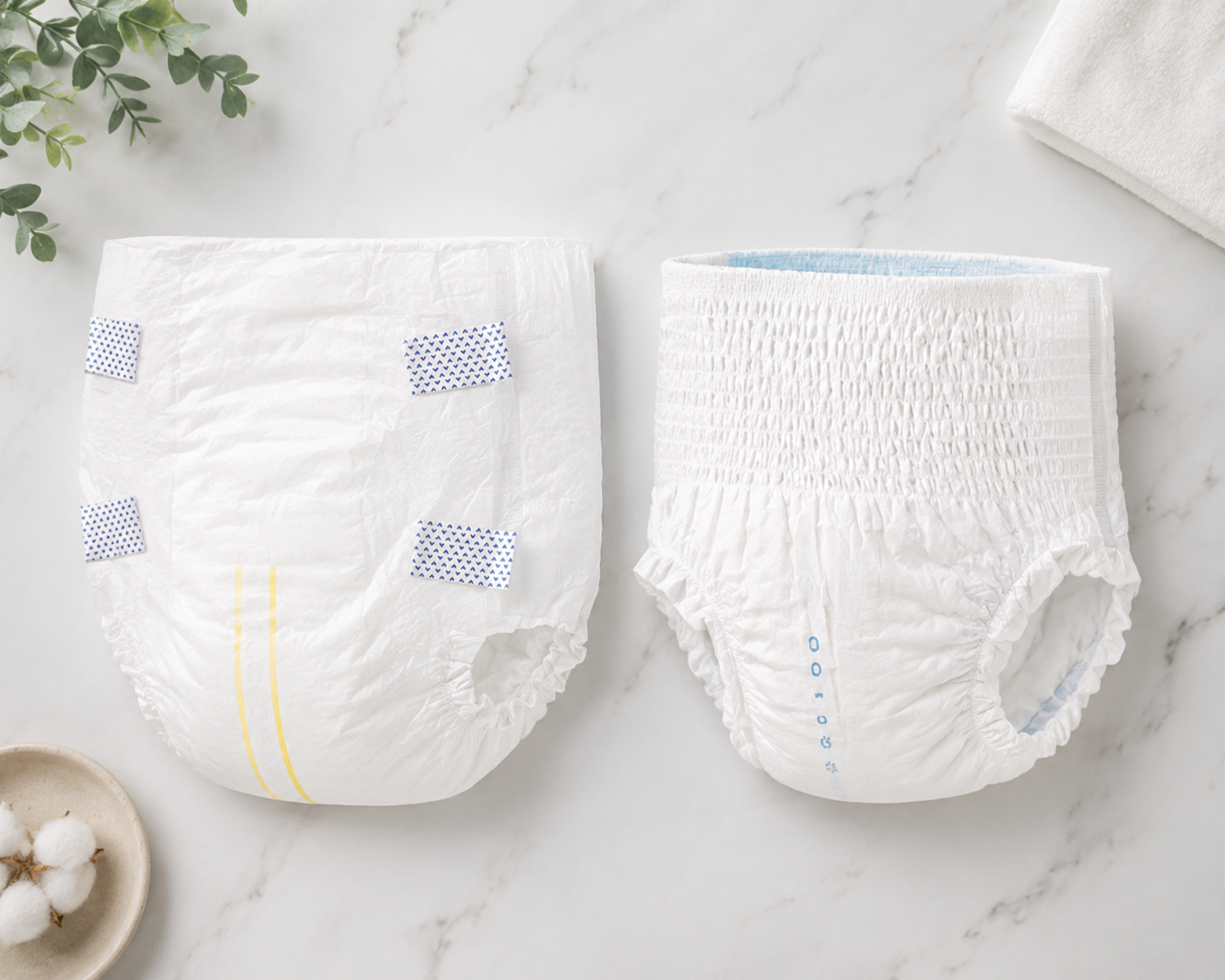
Adult diapers (tabbed briefs) have adhesive tabs on the sides, similar to a baby diaper, that fasten and unfasten. You put them on lying down or standing, and you can adjust the fit without taking them fully off.
Pull-up underwear looks and works more like regular underwear. You step into them, pull them up, and they stay in place with an elastic waistband. To remove them, you either pull them down like normal underwear or tear the sides.
That's the mechanical difference. The right choice depends on a few things specific to you.
When tabbed briefs tend to work better
- Higher absorbency needs. Tabbed briefs generally offer higher absorbency levels than pull-ups, making them a better fit for moderate to heavy incontinence or overnight use.
- Limited mobility. If bending, stepping into underwear, or standing for extended periods is difficult, tabbed briefs are easier to put on and take off, especially with assistance.
- Frequent changes. The refastenable tabs make changing quicker and cleaner without fully undressing.
- Overnight protection. The snug, adjustable fit and higher absorbency make tabbed briefs the more reliable choice for nighttime use.
When pull-up underwear tends to work better
- Lighter to moderate incontinence. If you're managing occasional leaks rather than full episodes, pull-ups offer enough protection without feeling like more than you need.
- Active lifestyle. Pull-ups move with you more naturally. If you're walking, exercising, or out for the day, they feel closer to regular underwear and are less likely to shift or bunch.
- Independence matters. If you're managing this on your own and want to change discreetly, in a public restroom, for example, pull-ups are faster and more straightforward.
- Dignity and discretion. Many people find pull-ups feel more "normal." That's not a small thing. Feeling comfortable in what you're wearing affects how you move through your day.
What about absorbency?
Both types come in a range of absorbency levels, light, moderate, heavy, and overnight. Absorbency matters more than product type in some cases, so it's worth thinking about:
- Daytime vs. nighttime: Nighttime almost always requires higher absorbency, regardless of which style you choose.
- Activity level: More active days mean more movement, and more movement means a better fit matters more than maximum absorbency.
- Frequency: If you're experiencing leaks occasionally vs. consistently, that changes what level you actually need.
A common mistake is starting with the lowest absorbency to feel like the situation is less serious. The better approach is to start with what actually matches your needs, then adjust from there.
Can you use both?
Yes, and many people do. Pull-ups during the day for comfort and mobility, tabbed briefs at night for higher absorbency and a more secure fit. There's no rule that says you have to pick one and stick with it. What works in the morning might not be what works at midnight.
The bottom line
If you need higher absorbency, have limited mobility, or want a more secure fit, start with tabbed briefs. If you're more active, managing lighter leakage, and want something that feels as close to regular underwear as possible, start with pull-ups. And if you're not sure, try both. Most people find their preference within a few days.
Ready to look at options? Browse our adult incontinence products, both tabbed briefs and pull-up underwear, in a range of absorbency levels and sizes.